
CRM, AI Agents and Follow-up
CRM, AI Agents and Follow-up: How to Stop Losing Deals That Were Already in Your Pipeline
By Gabriel Borges Aguiar · September 23, 2026 · 8 min read
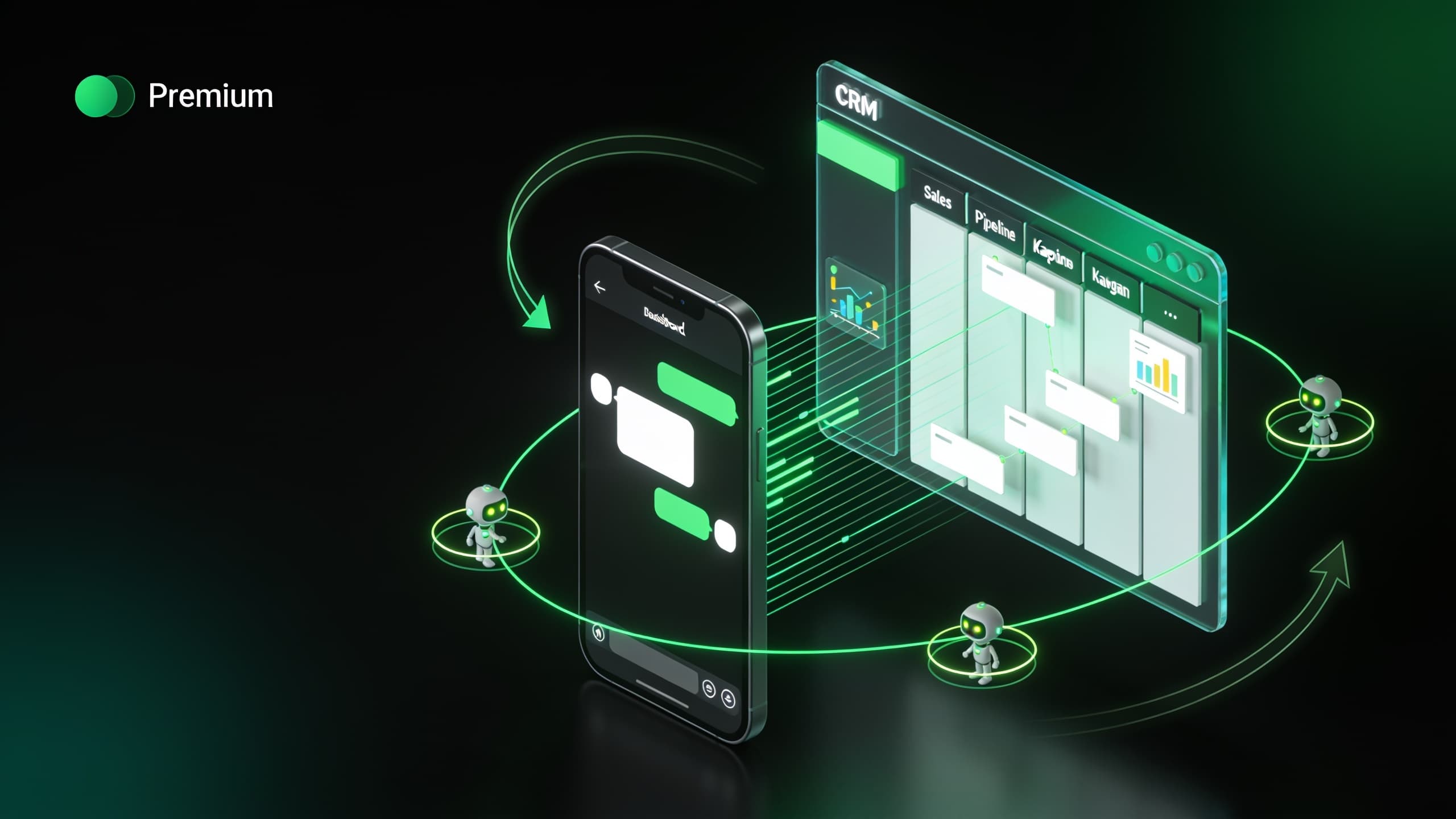
CRM, AI Agents and Follow-up: How to Stop Losing Deals That Were Already in Your Pipeline
A lead who messages you on WhatsApp at 9 p.m. and only hears back the next day was not lost for lack of interest. It was lost for lack of operation. The same applies to the proposal that never got a reply, the quote that was left "to think about" and the customer who asked to be contacted the following week. In many companies, sales do not die in negotiation. They die in the gap between one contact and the next.
Combining CRM, AI agents and AI sales follow-up closes that gap. The CRM holds the context, the agents run the conversation and follow-up ensures no opportunity sits idle without a defined next step.
For sales leaders, the question is no longer whether AI is worth using in sales. The question is whether the pipeline can respond at the customer's speed, with enough context to move each deal forward and a reliable record of everything that was done.
Where the pipeline leaks revenue
In most operations, the sales process depends on three things that do not scale: the rep's memory, the discipline to update the CRM and the time available to revisit conversations. As lead volume grows, the team naturally prioritizes whoever seems hottest and leaves the rest for later. "Later" rarely comes.
The result shows up in different ways. Leads get their first reply too late. Proposals go unanswered because nobody remembered to follow up. The CRM shows deals in stages that no longer match reality. And managers make decisions based on a pipeline nobody fully trusts.
There is also an opportunity cost. A customer ready to close on simple terms may buy from a competitor just because they got the right answer first. In sales, arriving late means negotiating with fewer chances.
Hiring more reps solves part of the volume problem, but not consistency. Each person follows up differently, records information differently and forgets different things.
A CRM without execution is a file of good intentions
The CRM is the source of truth for the sales operation. It holds customer history, deal stage, opportunity value and owner. The problem is that, in practice, it is only as good as the discipline of whoever feeds it.
When records depend on manual entry, the CRM is always one step behind the real conversation. The rep talks to the customer on WhatsApp, agrees on a new date, sends a document and only then, if time allows, updates the system. Often it does not.
The shift happens when the CRM stops being merely consulted and starts being operated. An AI agent with two-way integration reads the history before replying and writes the outcome of each interaction right after: new lead created, opportunity updated, stage moved, callback scheduled. The pipeline reflects what is happening now, not what someone remembered to log.
The role of AI agents in sales conversations
AI agents are not menu-based chatbots. They understand customer intent, consult business information and guide the conversation to the next stage of the pipeline.
In a mature operation, that work is not concentrated in a single generic bot. It is split among specialized agents working in parallel: one qualifies the lead, another answers technical questions based on the company's catalog and policies, another books meetings, another handles follow-up and another opens a ticket when the topic is support. This division makes responses faster and more accurate.
Accuracy is what separates a serious operation from a risky automation. The AI must answer only from information registered by the company, with validation layers that prevent invented answers about pricing, timelines or commercial terms.
Autonomy within company-defined limits
The company defines which leads the AI can handle alone, which criteria signal a bigger opportunity, which topics require a specialist and who each case should go to. The AI executes within that perimeter, 24 hours a day.
When the criteria indicate it is time for a human to step in, the agent does not simply transfer the conversation. It delivers a summary with the lead's profile, what was asked, what was answered and where the negotiation stands. The rep takes over without asking the customer to repeat everything.
Follow-up: where most sales are decided
Few sales close on the first contact. Most depend on a sequence of well-executed follow-ups, and that is exactly the stage that suffers most when the team is overloaded.
Effective follow-up is not sending "hi, how are you?" three days later. It is resuming the conversation with context: referencing the proposal sent, addressing the pending objection, offering the time slot the customer requested, sharing material relevant to their buying stage.
With CRM and AI agents working together, follow-up is triggered by real pipeline events:
Proposal sent with no reply after the defined period
Lead who asked to be contacted on a specific date
Open quote that has not moved stages
Abandoned cart in an e-commerce operation
Customer at a repurchase or renewal moment
Each touch adjusts tone and frequency based on stage and lead behavior. When the customer replies or buys, the sequence stops automatically. And every touch is logged in the CRM, so managers know exactly how many attempts were made and which message drove a response.
What AI takes on and what stays with the team
The best operation does not eliminate the salesperson. It eliminates repetitive execution so the salesperson can focus on deals that require relationship, strategy and judgment.
AI can safely take on high-volume, rule-based tasks: first response, qualification, frequently asked questions, sending materials, scheduling, follow-up, CRM updates and contextual handoff. The human team remains responsible for complex negotiations, strategic accounts, off-policy terms and decisions involving long-term relationships.
This balance protects the customer experience and gives managers a workforce that logs every interaction and allows intervention at any time.
Metrics that prove the operation is working
Message volume is not a results metric. An AI-powered sales operation must be measured by the speed and quality of pipeline progress.
Track time to first response, follow-up reply rate, stage-to-stage conversion, average sales cycle and reactivation rate of stalled leads. One metric that often reveals a lot is the number of opportunities with no defined next step: the lower it is, the healthier the pipeline.
It is also worth measuring the share of conversations resolved without human intervention and customer satisfaction after contact. If conversion rises but satisfaction drops, the approach needs adjustment. With real-time dashboards, those adjustments happen within the same week, not at month-end.
Four steps to implement without disrupting the sales team
Implementation should start from the existing process. The goal is to have intelligence operate on the CRM and channels the company already uses, without switching systems.
Organize the pipeline and criteria. Define stages, what makes a lead qualified, when an opportunity should go to a human and which timeframes trigger follow-up. A confusing pipeline produces confusing automation.
Connect CRM, WhatsApp and knowledge base. The AI must read and write to the CRM, operate on an official number and consult catalog, pricing, policies and approved answers. Without that, it responds without context.
Start with a critical stage. Proposal follow-up and first response to new leads are usually where the biggest losses happen. Validate language, cadence and handoff criteria before expanding.
Scale with sales targets. Compare results against the baseline: response time, stage conversion, sales cycle and team productivity. Expansion should be guided by metrics.
Vendedor IA was designed for this operating model. More than 30 specialized agents work in parallel on the official WhatsApp Business API, read and update the CRM with every interaction, run follow-up and hand off to the right person with a complete conversation summary. Everything is configured by the company itself in the admin panel, with no IT dependency to operate.
What to evaluate before choosing a solution
An AI sales solution needs to do more than reply to messages. Check whether it writes to the CRM, not just reads from it. Confirm that follow-up is triggered by pipeline events and stops when the customer replies. Evaluate whether there is protection against invented answers and whether human handoff comes with context.
Integration is also decisive. Switching CRMs to adopt automation increases risk and time. The right platform connects to what already exists, whether Salesforce, HubSpot, RD Station, Pipedrive or a custom system.
Finally, demand traceability. Managers need to know what was said, which follow-up was sent, why a lead was handed off and what result each flow produced.
No sale is guaranteed by a single message. But an operation that responds instantly, resumes every conversation at the right moment and keeps the CRM true to reality stops depending on the team's memory. It starts treating the pipeline as an asset that works 24 hours a day.
Frequently asked questions
What is AI sales follow-up?
It is the automatic resumption of sales conversations by AI agents, triggered by pipeline events such as an unanswered proposal or an agreed callback date, using the history recorded in the CRM as context.
Do AI agents replace the CRM?
No. The CRM remains the source of truth. AI agents operate on top of it, reading history before replying and recording the outcome of each interaction.
Can the AI hand the conversation to a salesperson?
Yes. When the company's criteria are met, the AI routes the conversation to the responsible person along with a complete summary.